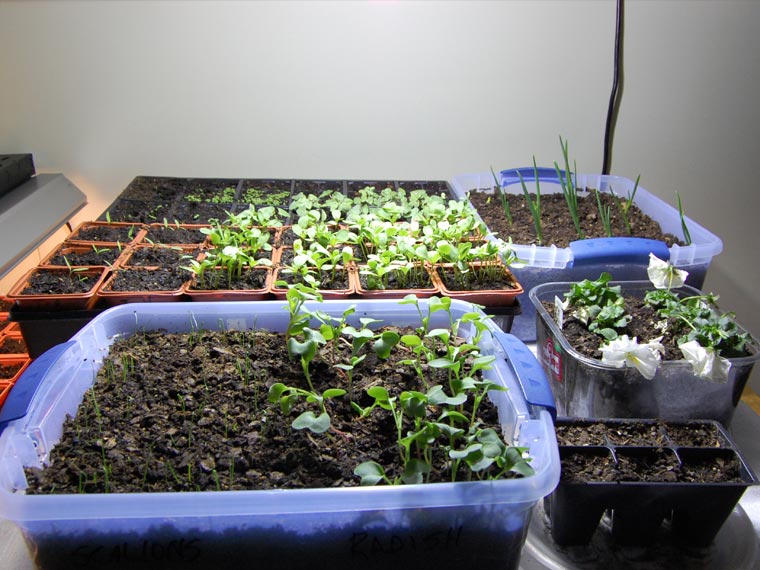
A Central Florida pepper start has two indoor seasons: late winter for the January to March set, and midsummer for August to September. UF/IFAS Gardening Solutions (Peppers) says to start seed indoors because small seed washes away in the garden. The choice is where that tray sits, a bright windowsill or an overhead grow light.
What IFAS actually says about light
UF/IFAS Gardening Solutions, Starting Transplants Indoors, is the Florida gardener page for this choice. It says you can start seeds on a windowsill, then lists reasons to install overhead lights instead:
- Space near windowsills is limited and will not support dozens of transplants.
- Only south- or west-facing windows are bright enough to start strong seedlings.
- Windowsill light is directional, so seedlings bend toward it. Rotate trays 180 degrees every couple of days so the bend does not become permanent.
- Seeds not receiving enough light grow tall and leggy.
- If you are starting more than a dozen seedlings, IFAS suggests an overhead light source.
On the same page: fluorescent and LED lights are inexpensive, not too warm, and come in sizes that fit just about anywhere in a home; they can go on timers. Position the light directly above the plants. The closer it is, the more light they get, and the less hardening-off they need to move into full sunlight.
That page also names peppers among warm-season crops that germinate best in warm soil. If germination is low, a horticultural heat mat may help. Light and heat are separate tools.
Windowsill, when IFAS allows it
- South- or west-facing window only (their brightness sentence).
- A small tray, not dozens of cells.
- Rotate 180° every couple of days.
- Watch for tall, leggy stems. That is their “not enough light” sign.
Grow light, when IFAS prefers it
- More than a dozen seedlings.
- No south- or west-facing window, or the sill is already full.
- Overhead fluorescent or LED, on a timer if you want less daily fuss.
- Light close and directly above, so plants stay stocky for the move outdoors.
A four-question check
- Is the window south- or west-facing? IFAS says only those are bright enough. North or east is not their sill path.
- Are you starting more than a dozen seedlings? If yes, IFAS suggests overhead light even if the sill is good.
- Can you rotate 180° every couple of days? If not, directional sill light will bend stems.
- Are stems already tall and leggy? IFAS reads that as not enough light. Move under an overhead fixture or sow fewer cells.
Four yeses on 1 and 3, with no on 2 and 4, is the IFAS windowsill path. Any no on 1 or 3, or yes on 2 or 4, is the grow-light path. This is their page, not a house rule.
Central Florida dates, not a northern calendar
Ask IFAS HS732 lists Central Florida planting as August to September and January to March. UF/IFAS Peppers independently says start indoors in late winter for planting after the last spring frost, and start again in midsummer for an early-fall planting in August and September. UF/IFAS Starting Transplants Indoors adds the lead time: aim to start seeds indoors 4 to 8 weeks before the suggested outdoor planting dates. Pair those three hosts. Do not borrow a Pennsylvania last-frost chart. The Central Florida guide walks the bulletin windows.
January to March slot
4 to 8 weeks before January is roughly November to December indoors; 4 to 8 weeks before March is January to February. That overlaps IFAS Peppers’ “late winter” sentence. Days are still short. The south/west-window test is the one that matters.
August to September slot
4 to 8 weeks before August is June to July. The same midsummer indoor start IFAS Peppers names. Days are long. IFAS still wants overhead light above a dozen seedlings, and still wants rotation on a sill. Do not skip the rotate step because it is June.
Worked example. Two indoor starts, two light questions. A late-winter tray (aimed at the January to March HS732 slot) sits indoors while Florida days are still short. A north kitchen window is not the IFAS sill sentence. A midsummer tray (aimed at August to September) sits indoors while days are long; count the cells anyway. Five varieties on this hub at one cell each is five seedlings. Under a dozen. Four cells of each is twenty. Over a dozen, so IFAS already suggested a light before anyone argues about June sun through glass.
University of Maryland Extension lists pepper as about eight weeks indoors before transplant. That is a Maryland timing note, not a Central Florida frost almanac. Use it only as a peer check against IFAS’s 4 to 8 week band.
Peer Extension is stricter than IFAS on sills
University of Maryland Extension (Starting Seeds Indoors): natural light from a window is seldom enough for good, strong seedling growth; stems stretch and lean; acceptable growth usually only occurs in south-facing bay windows or solariums. Penn State Extension Master Gardeners (Adams County, Starting Seeds): starting seeds in a brightly lit window is difficult; if that is the only option, use a south-facing window; supplemental lighting is best. Those are not Florida pages. They are named here so the IFAS “you can start on a windowsill” sentence is not the only host in the room.
IFAS does not print a Central Florida-only lux table for January versus July sills. A late-winter start in Central Florida is the slot where an overhead light most often earns its place. Shorter days, more north-facing rooms in use, more than a dozen cells if you are sowing jalapeño plus a hot cultivar. A midsummer start on a true west or south sill may carry a small tray if you rotate as IFAS says; IFAS does not say that “Florida summer sun through glass” replaces an overhead light. If stems stretch, IFAS already told you what that means: not enough light. Move the tray under a light, or buy fewer cells.
Heat is not light, and closer light is not full sun
IFAS Starting Transplants Indoors: peppers germinate best in warm soil; a heat mat intended for horticultural use may help if germination is low. The same page says the closer the overhead light, the more light the plants get, and the less hardening-off they need to move into full sunlight. Penn State’s Growing Hot Peppers page is about pungency and outdoor full sun, not about indoor fixtures. Do not treat a west window as a heat mat, and do not treat a grow light as a substitute for the Hot Peppers full-sun sentence once the plant is outside. Datil still prefers 60 to 70% shade on its own IFAS page after transplant. Indoor start light does not rewrite that. See heat and sun and the datil card.
First-tray shopping (seeds, trays, mix; light only if this page says it belongs) lives on the seed-starting kit. Cited seed calendar: seed start.
Sources
- UF/IFAS Gardening Solutions, Starting Transplants Indoors. https://gardeningsolutions.ifas.ufl.edu/care/planting/starting-transplants-indoors/
- UF/IFAS Gardening Solutions, Peppers. https://gardeningsolutions.ifas.ufl.edu/plants/edibles/vegetables/peppers/
- Ask IFAS HS732 / CV130. https://ask.ifas.ufl.edu/publication/CV130
- University of Maryland Extension, Starting Seeds Indoors. https://extension.umd.edu/resource/starting-seeds-indoors
- Penn State Extension Master Gardeners, Adams County, Starting Seeds. https://extension.psu.edu/programs/master-gardener/counties/adams/news/starting-seeds
Updated 2026-08-31. Back to grow.